Table of contents
You get your thyroid labs back. The portal says normal. Your doctor says to watch it. But you're still dragging through the afternoon, losing mental sharpness, feeling cold when everyone else is comfortable, or wondering why your weight and energy don't match your habits.
That disconnect is where a lot of people get stuck.
The problem isn't that TSH doesn't matter. It does. The problem is that many people are taught to think in only two categories: normal or abnormal. Real biology is messier than that. A lab can tell you that you're not in obvious thyroid failure while still missing the question most proactive people care about: Is this level ideal for how I want to feel and function?
That distinction matters if you're interested in prevention, performance, and long-term health, not just avoiding disease.
The 'Normal' Lab Result Paradox
A common story goes like this. Someone feels off for months. They finally ask for labs. The result comes back inside the reference range, so the conversation ends there.
But symptoms don't disappear because a portal used black text instead of red.
TSH, or thyroid stimulating hormone, often sits at the center of that frustration. It's one of the first markers clinicians check when they want to understand thyroid function. Yet it's also one of the easiest markers to oversimplify.
Why normal can still feel wrong
A reference range is built to help identify overt disease in a broad population. That's useful. It helps clinicians catch clearly dangerous patterns and know when treatment needs to happen quickly.
It doesn't automatically tell you where your body works best.
For most non-pregnant adults, the standard TSH reference range is 0.4 to 4.0 mIU/L, though some labs use slightly different cutoffs such as 0.5 to 5.0 mIU/L, according to Ubie Health's overview of TSH ranges and concerning thresholds. That means two people can both be labeled normal while sitting in very different physiological situations.
One may feel steady, warm, mentally clear, and resilient. Another may feel sluggish and dismissed.
The hidden question behind the lab result
Those interested in the TSH optimal range are usually not asking for a trivia answer. They're asking something more practical.
They want to know:
Energy: Is my thyroid contributing to fatigue?
Metabolism: Could this be affecting weight, hunger, or temperature tolerance?
Cognition: Is brain fog tied to thyroid signaling?
Prevention: Am I drifting in the wrong direction before obvious disease shows up?
Those are valid questions. And they require a more nuanced view than "your result is normal, so you're fine."
Understanding Your Body's Thyroid Command Center
Your thyroid system makes more sense when you stop thinking of it as one gland and start thinking of it as a control network.
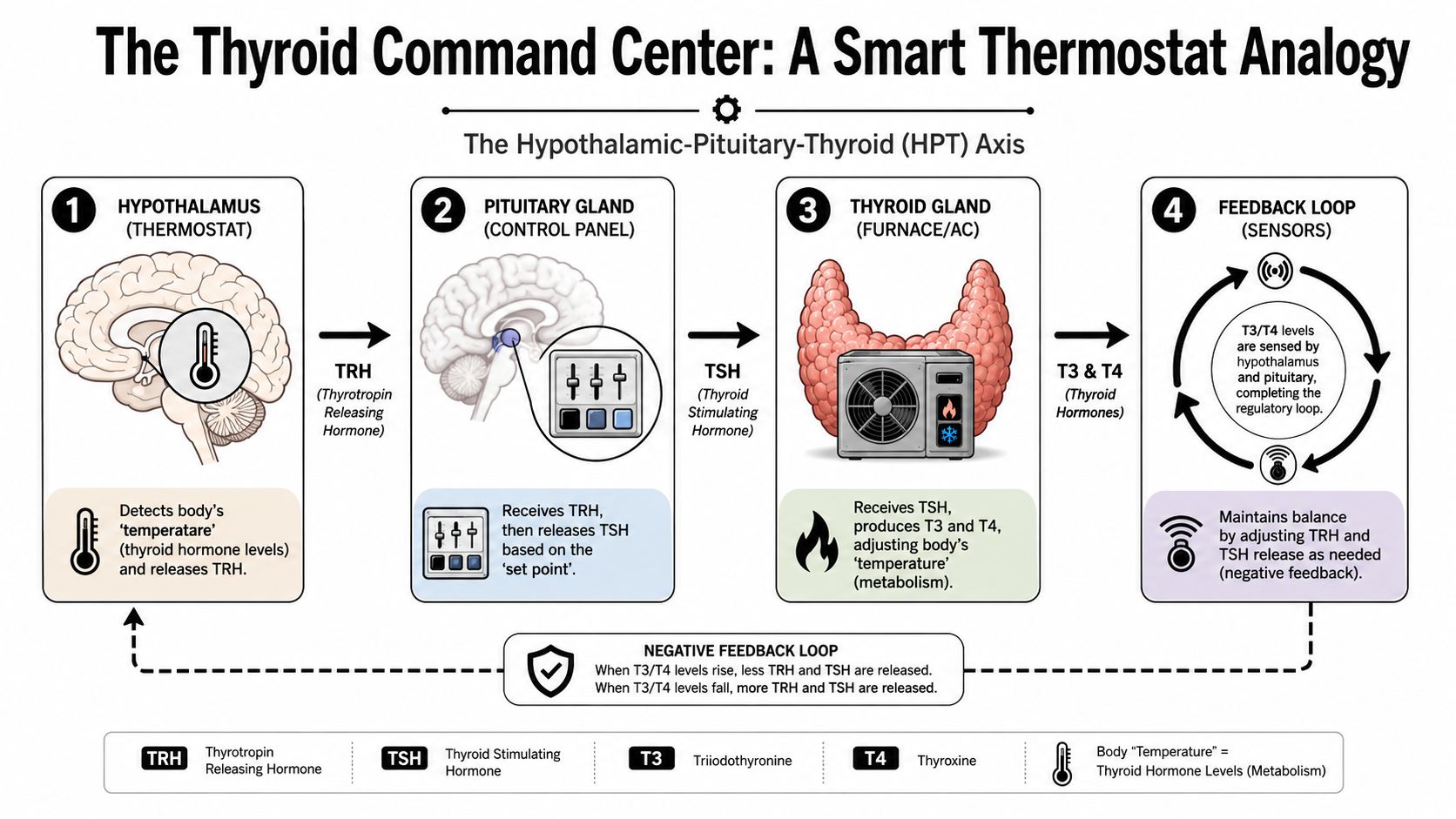
The easiest analogy is a smart home heating system. Your body is the house. It wants a stable internal environment. The brain and thyroid work together to keep that environment in range.
The thermostat model
Here's the simplified version of the Hypothalamic-Pituitary-Thyroid axis, often called the HPT axis:
Hypothalamus This is like the homeowner deciding the target temperature. It monitors the body's internal state and starts the signaling process.
Pituitary gland This acts like the thermostat control panel. It receives input and sends the thyroid its marching orders.
Thyroid gland This is the furnace. It produces thyroid hormones, mainly T4 and T3, which help regulate metabolism, temperature, energy use, and more.
Feedback loop As thyroid hormone levels rise or fall, the brain senses that change and adjusts the signal.
Where TSH fits
TSH is the signal, not the final product.
If your body senses that thyroid hormone activity is too low, the pituitary sends a louder signal. TSH rises. It's like the thermostat cranking up the call for heat because the house feels cold.
If your body senses that thyroid hormone activity is high, the pituitary quiets down. TSH falls.
This is why a high TSH often points toward an underactive thyroid pattern, while a low TSH can point toward an overactive pattern. But because TSH is an indirect signal, it never tells the whole story by itself.
Why this matters in daily life
Many people assume TSH is the thyroid hormone. It isn't. It's the command sent to the thyroid.
That distinction helps explain why someone can have symptoms even when the signal doesn't look dramatic. You aren't just interested in whether the thermostat is shouting. You care whether the house is comfortable.
Body temperature can be one clue in that bigger picture, especially when you're correlating symptoms and physiology over time. If you want a related marker to understand in plain language, OneTwenty's explainer on body temperature as a biomarker is a useful companion.
Lab Reference Range vs The Optimal TSH Range
This is the core distinction.
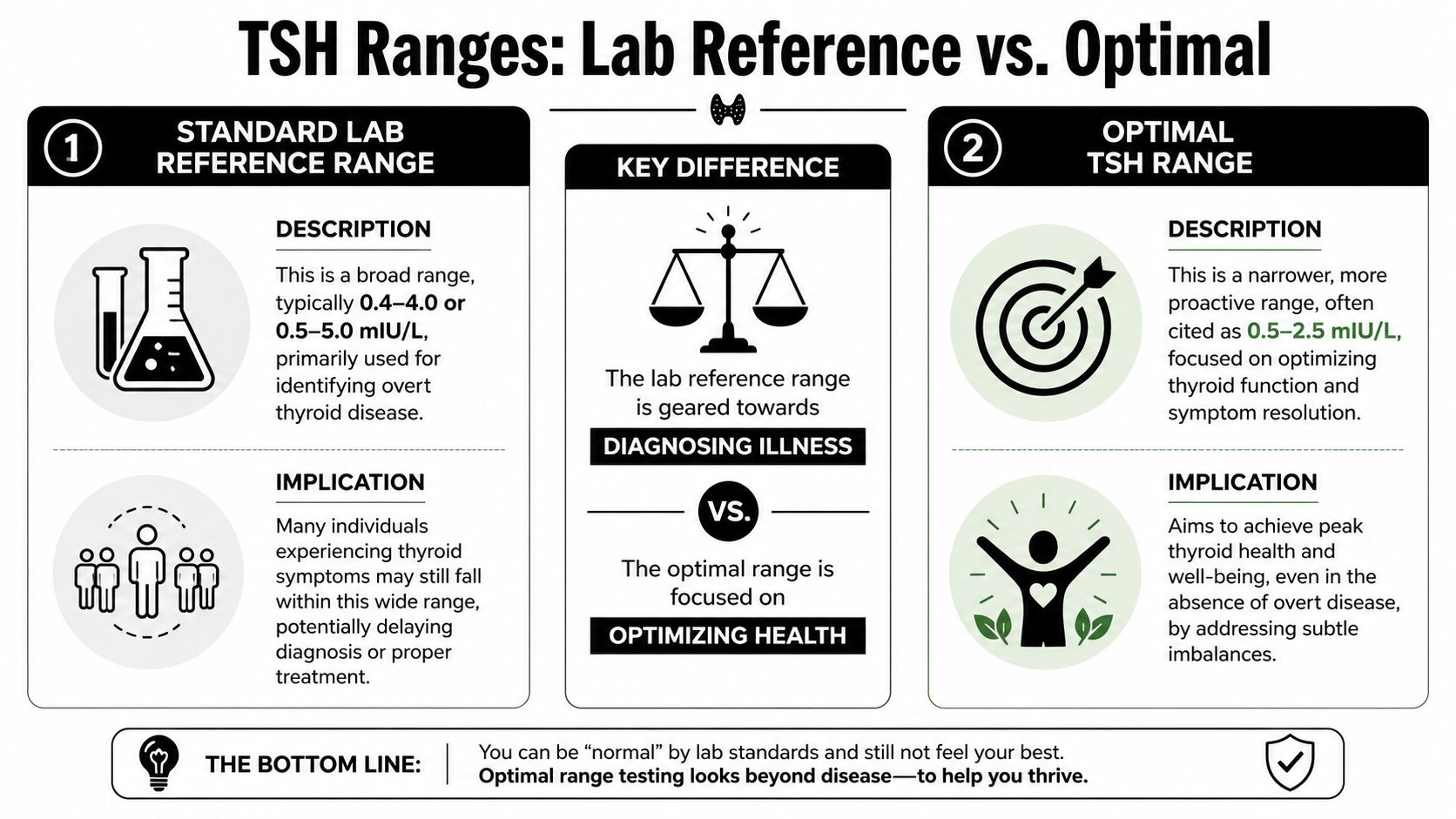
A lab reference range asks, "Does this value fall inside the broad limits commonly used to detect obvious disease?" An optimal range asks, "Where is thyroid signaling most likely to support better function and lower risk?"
Those aren't the same question.
The standard range is broad by design
Standard clinical references often define normal TSH as 0.4–4.5 mIU/L, while many labs and clinicians use very similar boundaries. That range is useful for screening. It helps identify overt hypothyroidism or hyperthyroidism.
It is not designed to tell you the narrowest range associated with the best outcomes or the lowest likelihood of subtle thyroid dysfunction.
One practical issue is that a "normal" range includes many people who are not thriving. It may also include people early in a disease process.
What the optimal range argument says
Emerging and functional-medicine-oriented interpretations are narrower. According to OptimalDX's update on TSH ranges, standard references define normal TSH as 0.4–4.5 mIU/L, but the optimal TSH range is often framed as 1.0–2.0 mIU/L, and approximately 95% of healthy, euthyroid individuals maintain TSH levels below 2.5 mIU/L.
That doesn't mean every value outside 1.0 to 2.0 is pathological. It means the broad lab range may be too permissive if your goal is optimization rather than rule-out medicine.
Later in the same conversation, many clinicians and health optimizers use a practical target of roughly 0.5–2.5 mIU/L as a narrower zone worth paying attention to, especially when symptoms are present. The key idea is the same: a value can be technically normal without being ideal.
This short video gives a useful visual primer before you review your own labs:
A better way to read your result
Instead of asking only, "Am I in range?" ask three more specific questions:
Where am I within the range A TSH near the high end of normal may carry a different meaning than one closer to the middle.
Do my symptoms match the number Labs should inform the conversation, not replace it.
Is this stable or drifting A trend toward the edge of the range matters more than a single isolated result.
If you struggle to decode the way different labs present thyroid values, this guide to medical report formats can help you understand what you are looking at before you discuss it with a clinician.
Why Your Optimal TSH Target Is Personal
A personalized TSH target is more useful than a one-size-fits-all number.
Two people can share the same lab result and need very different next steps. The reason is simple. TSH is a signal, not a diagnosis. It reflects how hard your pituitary is pushing the thyroid system, and that signal is shaped by age, pregnancy, medication use, symptoms, and your broader hormone pattern.
Age changes what "usual" looks like
TSH often shifts over the lifespan, so the same value can carry a different meaning in a 30-year-old and a 75-year-old. Older adults may run somewhat higher TSH levels without having the same clinical picture seen in a younger person with fatigue, cold intolerance, or unexplained weight change.
That matters because optimization is not the same as normalization. A lab may label both results "in range," yet the healthier target for one person may be different from the healthier target for another. If your goal is long-term function, energy, and lower risk over time, context has to come first.
Pregnancy and treatment call for narrower decision-making
Pregnancy changes the stakes. Thyroid hormone supports early fetal development, so clinicians often aim for tighter control than they would in the general adult population.
Treatment adds another layer. Someone taking thyroid medication is no longer using TSH only as a screening marker. They are using it to judge dose fit. In that setting, a "normal" result can still be a poor match if symptoms persist, if hormone levels are off balance, or if the dose causes signs of overtreatment.
Reviewing Free T4 and Free T3 ranges together with TSH gives a clearer picture of whether the number on the page matches what is happening in the body.
Personalization works better than a fixed rule
A practical target should account for life stage, symptom burden, and whether your numbers are stable or drifting over time. That is the difference between reactive care and proactive care.
Population | Standard Lab Range (mIU/L) | More Useful Targeting Approach |
|---|---|---|
Most non-pregnant adults | 0.4 to 4.0 | Interpret in context of symptoms, trends, and other thyroid markers |
Pregnancy | Different from the general adult screening range | Usually managed with tighter clinician-guided targets |
Older adults | Standard range may be less informative on its own | Consider age, symptoms, and whether the value is stable |
People on thyroid medication | Standard range still offers context | Adjust based on symptom response and hormone balance |
The best target is the one that fits your biology, not the average person in a reference population.
That is why continuous tracking matters. A single TSH result is like one frame from a movie. A pattern over time shows direction, variability, and whether your thyroid is staying in a range that supports how you feel and how you want to age. Data-driven tools such as OneTwenty make that optimization mindset more practical by helping you follow trends instead of reacting to one isolated result. If you are also addressing the broader hormone picture, these science-backed hormone solutions can be part of that conversation with your clinician.
Looking Beyond TSH for the Full Thyroid Story
TSH is the front door to thyroid assessment. It isn't the whole house.
If you want a more complete picture, you need to look at the actual thyroid hormones and, in many cases, thyroid antibodies. That's where the difference between screening and real understanding becomes obvious.

Why TSH alone can mislead
TSH tells you how hard the pituitary is signaling. Free T4 tells you how much unbound thyroid hormone is available in the main storage form. Free T3 helps you understand the active hormone that cells use more directly.
That matters because symptoms happen in the body, not on a lab graph. A person can have a TSH that doesn't raise alarm while still having a hormone pattern that deserves attention.
Recent longitudinal research adds an important layer here. It identified the 60th to 80th percentile of normal TSH values as the safest zone for minimizing cardiovascular disease and all-cause mortality, with a median TSH of 1.90 mIU/L. It also found that people with Free T4 levels in the 20th–40th percentile had the least risk of death, underscoring that thyroid interpretation improves when you evaluate both markers together, according to this ScienceDirect abstract on healthy thyroid hormone ranges and mortality risk.
The missing marker many people overlook
Antibodies matter because they can reveal autoimmune thyroid disease, especially Hashimoto's thyroiditis, before the rest of the picture becomes obvious. Two common antibody tests are TPO antibodies and TgAb.
If antibodies are increased, the question changes. You aren't only asking whether thyroid output is currently adequate. You're also asking whether the immune system is actively targeting thyroid tissue.
That can explain why someone fluctuates over time.
A more useful thyroid panel
If you're trying to understand symptoms or optimize your TSH optimal range, ask whether your workup includes:
TSH for pituitary signaling
Free T4 for circulating available thyroid hormone
Free T3 for active hormone context
TPO antibodies and TgAb for autoimmune clues
For a plain-language breakdown of the hormone side of the panel, OneTwenty's page on Free T4 and T3 biomarkers is a helpful reference.
If you're also exploring broader recovery, stress, and endocrine support, this overview of science-backed hormone solutions can give you useful context for the kinds of lifestyle and supplement conversations people often have alongside thyroid testing.
Navigating Testing Pitfalls and Finding Your Pattern
A thyroid result is only as useful as the conditions under which you got it.
People often treat one annual blood draw as the final answer. That's risky. TSH moves. Your physiology changes. Testing conditions can skew the result enough to confuse the picture.
Common reasons a thyroid test can mislead
Several things can distort interpretation:
Timing of the blood draw TSH follows a daily rhythm. If one test was done early and another much later, comparison gets messier.
Acute illness or major stress A rough week, poor sleep, infection, or intense physiological stress can temporarily shift the thyroid picture.
Supplement interference High-dose biotin is a well-known reason clinicians ask patients to pause certain supplements before bloodwork.
Medication inconsistency Taking thyroid medication differently from one test to another can blur whether a change came from your body or your routine.
The better question is trend, not snapshot
A single number can be noisy. A repeated pattern is much more informative.
If your TSH sits in one zone across multiple tests, and that pattern matches how you feel, you have something actionable. If it swings around, the swings matter. If it slowly climbs, that drift matters too.
Proactive testing beats reactive testing. Instead of waiting until symptoms become impossible to ignore, you monitor often enough to notice direction.
How to make your results more comparable
Use a repeatable process:
Test under similar conditions Try to use the same time of day and similar pre-test habits.
Track symptoms alongside labs Write down fatigue, sleep quality, cold intolerance, mood, digestion, training performance, and menstrual changes if relevant.
Keep supplement and medication timing consistent If your clinician gives instructions, follow the same setup every time.
Look for movement over time Don't obsess over tiny differences. Focus on whether the broader pattern is stable, improving, or drifting.
Take Control of Your Thyroid Health With OneTwenty
Learning about thyroid optimization is useful. Turning it into a system is what changes behavior.
Thyroid health is often managed through scattered data. One lab here. A wearable app there. Symptoms in their head. Follow-up months later, if at all. That setup makes it hard to spot patterns, connect physiology to daily performance, or see whether an intervention is helping.
A platform built for continuous health tracking changes that experience.
What a connected approach looks like
The value of quarterly labs isn't just more data. It's better context. Regular testing helps you move away from one-off interpretation and toward trend recognition.
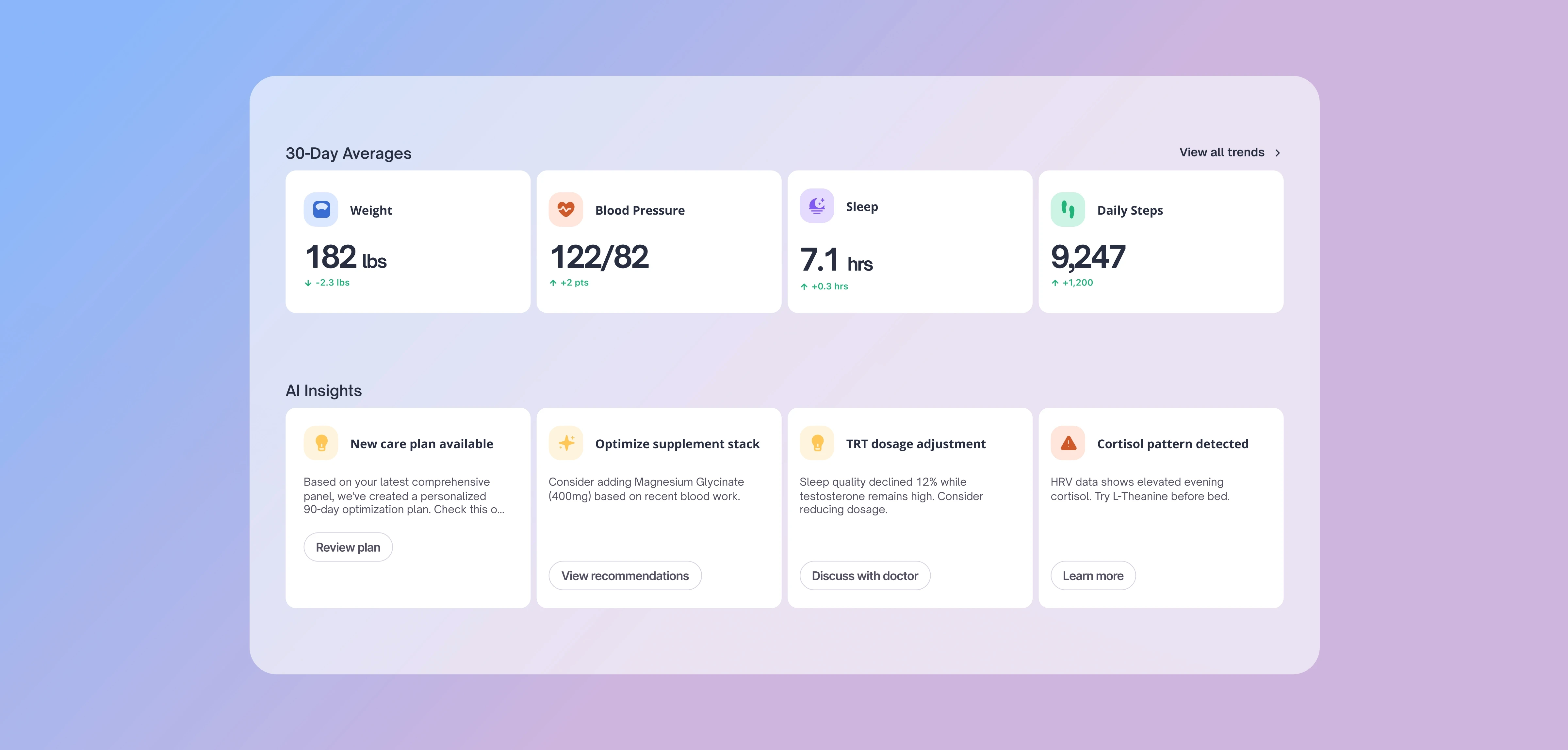
When you combine that with wearable signals such as sleep, activity, recovery, resting metrics, and body weight trends, you can start asking more useful questions:
Is a thyroid shift lining up with poorer sleep or lower recovery?
Are changes in treatment or habits reflected in energy and daily performance?
Is a symptom trend showing up before the lab crosses a conventional threshold?
That is the actual shift from normalization to optimization.
Why this matters for longevity-minded people
Thyroid health touches metabolism, temperature regulation, cardiovascular strain, mood, cognition, and resilience. If you care about healthspan, you don't want to find thyroid issues late. You want to see changes while they're still manageable.
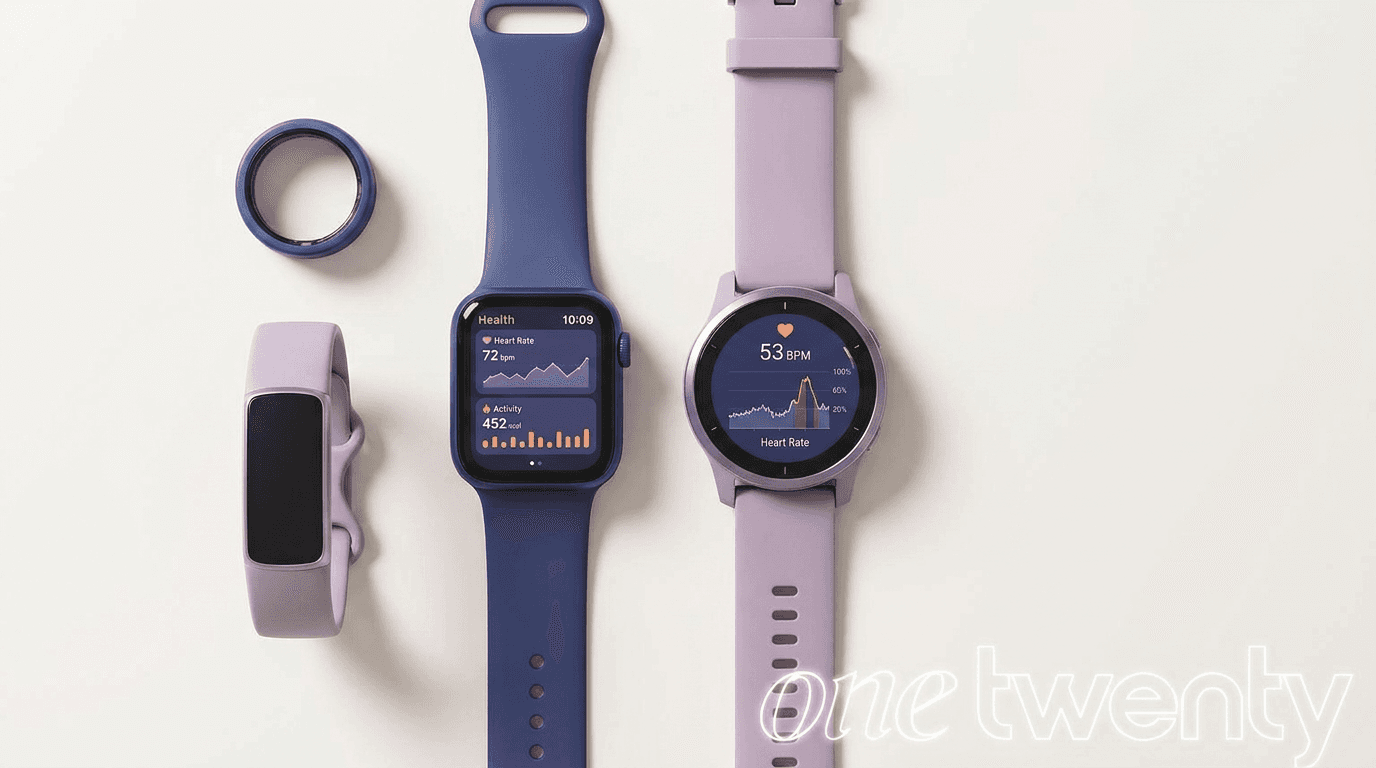
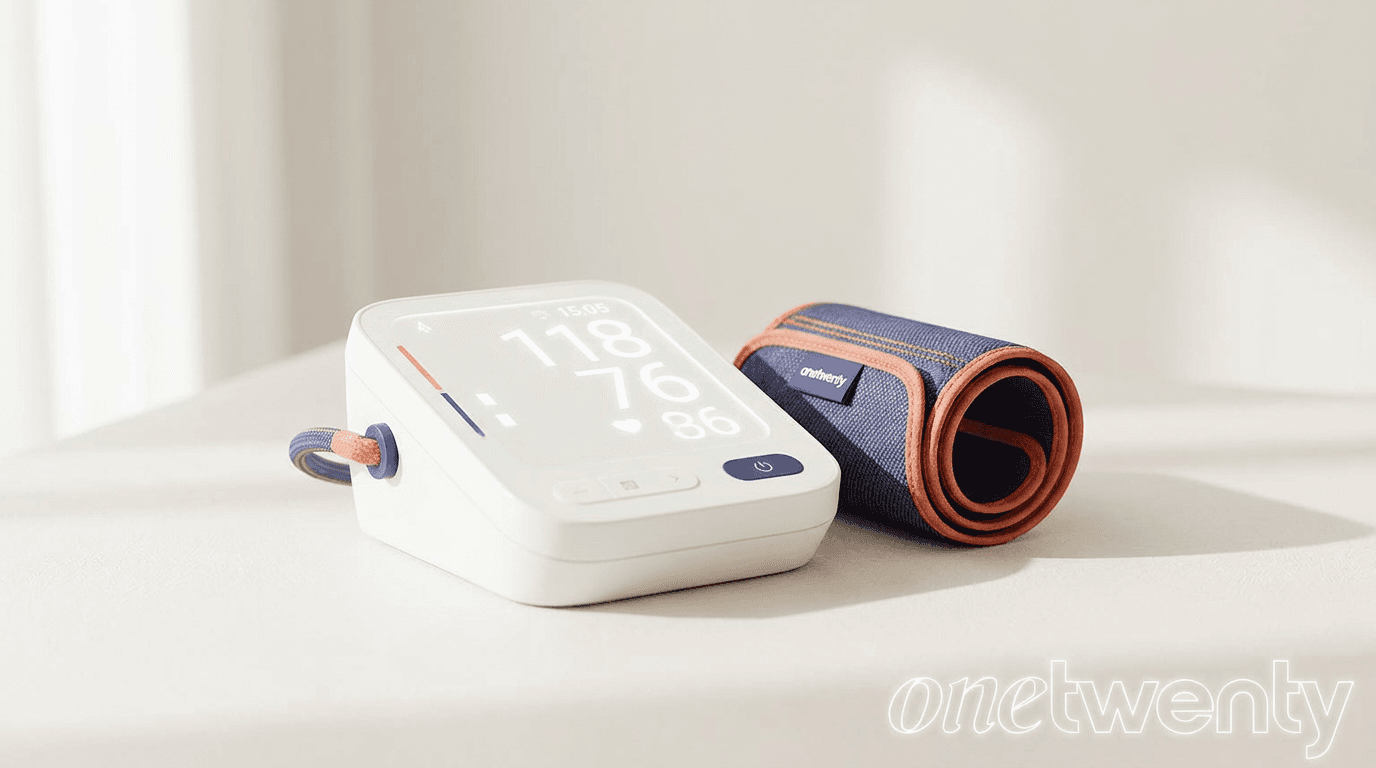
OneTwenty is built around that style of care. The platform combines quarterly personalized lab testing with wearable and home-device data so you can see your biology as a moving system, not a pile of disconnected reports. If you want the practical overview, the OneTwenty how it works page shows how lab trends, device integrations, and clinician-guided next steps fit together.
The goal isn't to chase perfection. It's to make better decisions sooner, with enough data to understand what your body is doing.
A grounded next step
If you've been told your thyroid is normal but you don't feel normal, don't stop at the flag on the lab report. Ask for the full context. Look at the pattern. Match the number to symptoms, hormones, and time.
That's how you find your real target.
If you want a more proactive way to track thyroid patterns alongside sleep, recovery, activity, and broader longevity markers, explore OneTwenty. It offers a connected view of labs and daily biometrics so you can move beyond isolated test results and make decisions based on trends, context, and your personal physiology.

How OneTwenty Works
Not your average
Checkup.
Every life stage brings new biological demands. Tracking the right metrics at the right time helps you adapt, optimize performance, and extend both lifespan and healthspan.
Your Annual Physical
Manual Data Processing
Guesswork Trend Detection
Once-a-year physical
Reactive, tested when sick
No data between visits
Once a year testing
Delayed Results
One-size dosing, set and forget
Real-Time Trend Insights
Daily smart-device data
Automated Data Sync
Quarterly Biomarker Tests
Optimal, personalized targets
Plain-language AI insights
Medications titrated to your data
Built to extend healthspan

Frequently Asked Questions
Clarity before
you commit
Answers on setup, scale, and support to remove blockers.